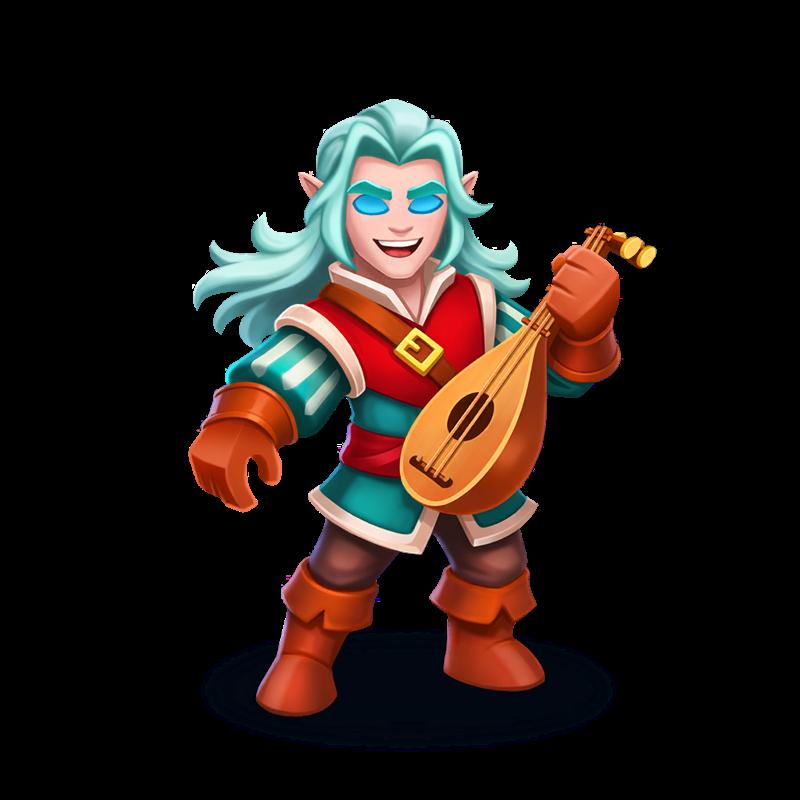
Toss a coin to your Witcher — or, in this case, to your Bard, who is absolutely also a Witcher. Long luscious whitish-green hair, glowing blue eyes, lute in hand, neck visible (which, for HvH heroes, is rare). The Bard is the newest hero in Heroes vs Hordes and the adventure hero for the month, which means he's grindable for free if you actually do your adventures.
This is a hero preview, so I'll walk through his base stats, level progression, globals, skills, forge, and a quick spin in try mode. I don't own him yet — we're working out of try mode on the regular account — but try mode tells you most of what you need to know about whether a hero can survive into the late game.
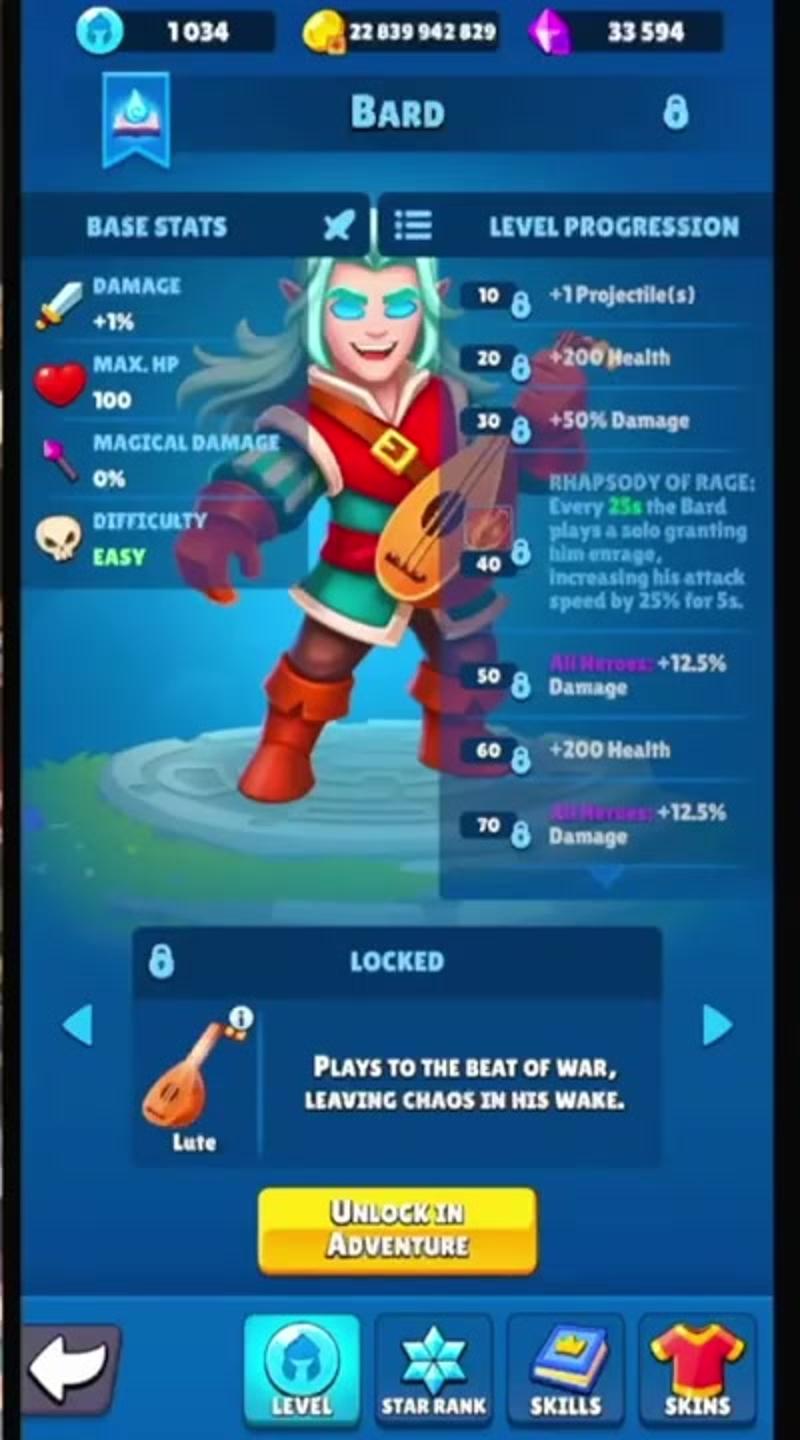
| 10 | +1 Projectile(s) |
|---|---|
| 20 | +200 Health |
| 30 | +50% Damage |
| 40 | RHAPSODY OF RAGE: Every 25s the Bard plays a solo granting him enrage, increasing his attack speed by 25% for 5s. |
| 50 | All Heroes: +12.5% Damage |
| 60 | +200 Health |
| 70 | All Heroes: +12.5% Damage |
| 80 | ECHO OF DISSONANCE: Every 15s the Bard creates an aura around him that slows enemies down by 50% and increases their dmg taken by 5%. |
| 90 | All Heroes that share Faction: +25% Damage |
| 100 | GRAND FINALE: All kills fill a meter, once full the Bard plays his masterpiece, shooting bouncing notes in all direction. Each note deals 360% damage on contact. |
| 120 | All Heroes: -2.5% Cooldown |
| 140 | Strong Stat Bonus: +3 Projectile(s) |
| 160 | All Heroes: +100% Damage |
The Bard is a magical damage hero in the Mage faction. His weapon is the Lute — a "masterwork lute infused with arcane resonance, flooding the battlefield with destructive music" — which evolves into Virtuoso's Lute. The base loot does not have a slow built in, which matters because most weapons in this game pick up a slow somewhere in the kit and his comes from the skills instead.
For an early game player, the talents you want from level progression are cooldown, area of effect, crit, and projectiles. The Bard hits projectiles at level 10 and damage at level 30, both of which scale very well early. After that things get rougher — health at 20 and 60 is filler, and the 140 strong stat bonus is +3 projectiles, which is genuinely strong (one extra projectile is roughly a 5-7% damage increase, so three lands in the 15-20% range right where a 140 bonus should be). Overall the base stat tree is on the weaker side. The 140 saves it.
Globals are what your hero gives the rest of your roster while sitting on the shelf. The Bard's are a mixed bag with one clear standout.
Two C-tier damage globals, a B-tier faction damage, an A-tier cooldown, and a B-tier stun multiplier. Mid overall, with the 120 cooldown carrying the package. Good enough for an adventure hero, which is the right context — adventure heroes are what you grind for free, so even a mid global package is worth the gem spend (~1,300-1,400 gems a month) to pick up.
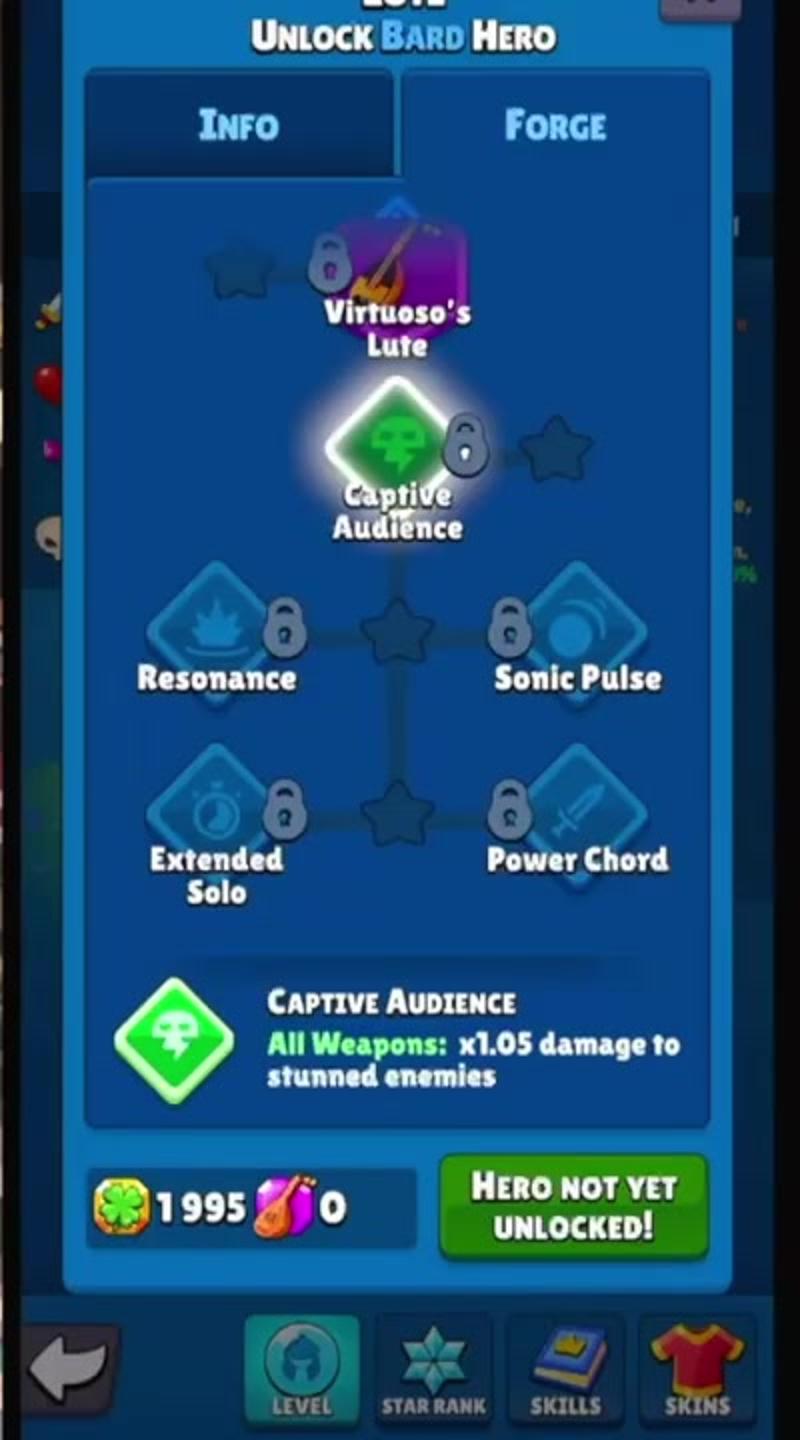
What you want from a forge is improvements to skills and the weapon, and you want choices up and down the tree so you can flex by game mode. The Bard's forge delivers — every level has a real decision attached to it.
Level 1: Two paths. Extended Solo increases Rhapsody of Rage's duration by 10 seconds, taking it from a 5-second buff to a 15-second buff. With the level-five 9-second cooldown, that's roughly 66% uptime on attack speed — which is huge in modes where attack speed actually scales. The other option, Power Chord, makes Rhapsody crescendo with raw fury for +15% damage during the effect. Power Chord is the better single-target pick (think Boss Brawl); Extended Solo is the better wave-clear pick.
Level 2: Resonance increases Echo of Dissonance's area by 50%. Or Sonic Pulse, which makes Echo of Dissonance apply push back. Both are great. More area means more enemies eating the slow and the damage-taken multiplier; push back is one of the strongest disruption tools in the late game and especially in Nightmare Mode. Pick by mode.
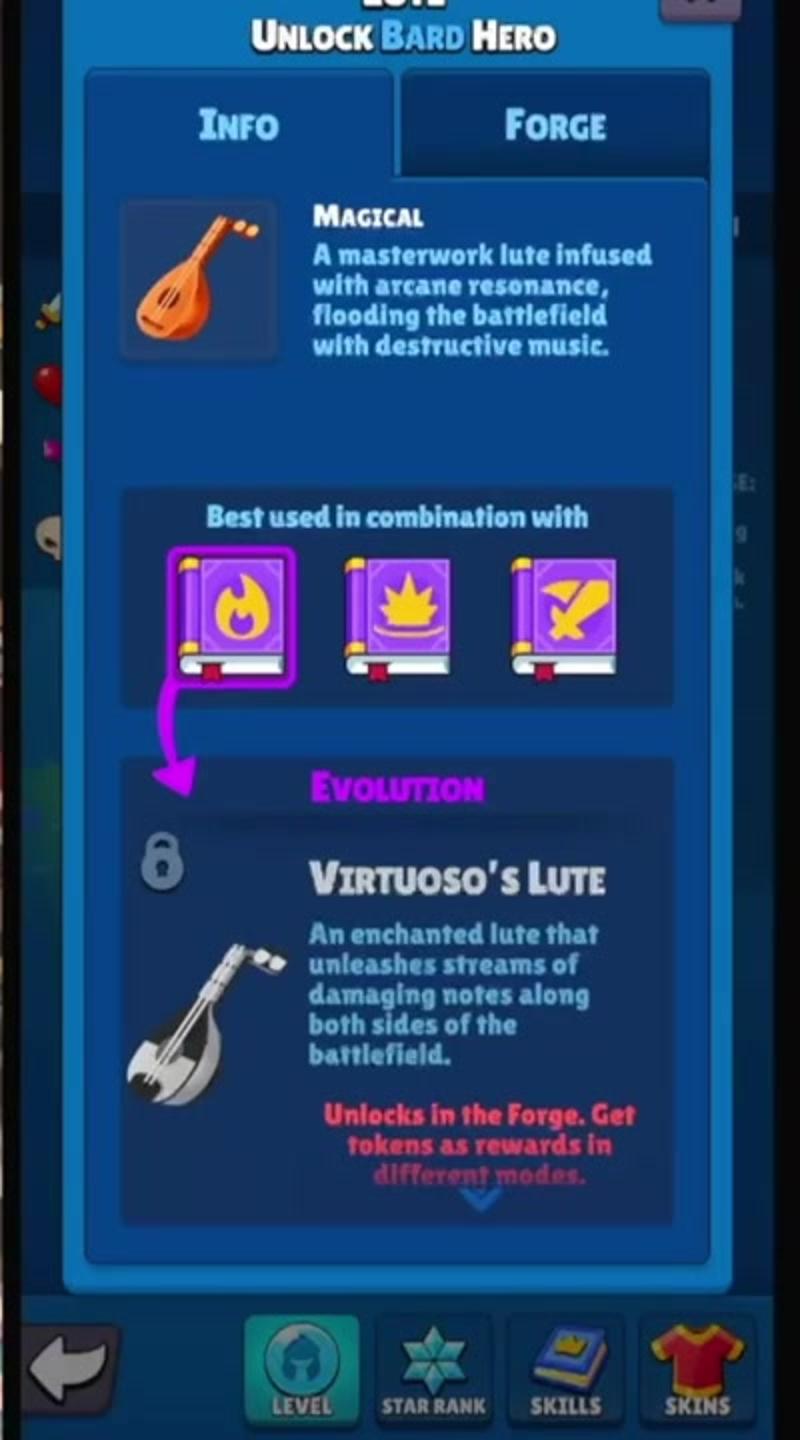
Level 4: Virtuoso's Lute. The weapon evolves and fires streams of damaging notes along both sides of the battlefield. Standard weapon evolution slot — there is no choice here, and you take it.
Level 5: Two paths. Songs of Fire gives notes a 100% chance to inflict burn for 300% burn damage over 3 seconds. Cool Tones gives notes the ability to freeze enemies, with frozen enemies receiving damage per tick. Burn is the easier status to layer because most kits already pair well with it; freeze is more disruption-heavy. The skill text on Cool Tones says "frozen enemies receive damage" but doesn't tie it back to a frozen-damage multiplier, which is a thematic mismatch — damage to frozen would have been the obvious pairing. Burn for damage, freeze for survivability and lockdown.
Choices up and down the tree, push back or extra slow on the aura, burn or freeze on the notes, attack speed uptime or single-target burst on the rage — this is good hero design. The fun part of HvH is the build decision before the run, and the Bard gives you something real to think about.
Skills are where a hero is made or broken, and adventure heroes scale especially hard with star levels. Most of these new heroes don't really pop until four stars — the four-star breakpoint combined with the strong stat bonus at 140 is when they start pumping real damage.
Every 25 seconds, the Bard plays a solo and gains enrage, increasing his attack speed by 25% for 5 seconds. By five stars the cooldown drops to 9 seconds, which moves the uptime from roughly 16% to 40%. That kind of attack speed scaling only matters if it works in the harder modes — Hard, Arena, Dragon's Tower. If it does, this is a real damage skill. If it doesn't, he's good early and weak late.
Every 15 seconds, the Bard creates an aura that slows enemies by 50% and increases their damage taken by 5%. By five stars that damage taken bonus scales to roughly 40%, which on a hero hitting 12,000+ damage is a massive multiplier. This is also expose in his kit, which is one of the more valuable status effects in the game. Compare to Druid's Wakening Whispers, which is every 10 seconds for 2 seconds at 80% (scaling to 110%) — Druid hits a higher cap, which is part of why Druid carries Boss Brawl. The Bard trades that ceiling for a permanent slow, which is a real survivability tool everywhere except Boss Brawl. Also: the description doesn't say how long the aura lasts. They give you the cooldown but not the duration, which is standard HvH practice and will never be fixed.
All kills fill a meter. When it pops, the Bard plays his masterpiece, shooting bouncing notes in all directions, each dealing 360% damage on contact. All-kills filter is solid — better than main-weapon-only — and the bouncing notes give him real map coverage. It feels a lot like Oracle's ultimate, but with notes. Scales tremendously well at four and five stars.
Try mode time. The bouncing notes are great — F minors, G flats, and C sharps everywhere, full map coverage, and the projectiles follow you across the screen so you have to position to line them up with packs. Cooldown should make them shoot faster, projectile speed should make them travel faster, and the visuals are easily an A+. Just a great-looking ultimate.
What he's missing: a shield, healing, or a stun. The S+ adventure heroes usually have at least one of those baked in, and the Bard does not. He has a slow and a push back from the forge, which keeps him alive in most modes, but he doesn't have the panic-button survivability that pushes a hero into S tier.
Where the Bard lands: solid A. Not S, not B. He's a fun hero with great thematics, real choices in his forge, an A-tier 120 cooldown global, and an ultimate that's genuinely entertaining to watch. He's especially good for newer players because he hits projectiles, damage, and area early in his level progression — which is exactly what you want from a hero you're grinding through your first few adventures. Pick him up. Always do your adventures.